Ask five window cleaners in Austin for a price and you will get five numbers, none of them explained. That is the real problem with pricing in this trade. The number is easy to say and awkward to justify, so most companies say it and hope you do not ask. This article asks. It is not a price list, because every building is different and a list would be a lie. It is an explanation of what you are actually paying for.
Most of the answer is the water
The biggest single cost in professional window cleaning is not the ladder, the squeegee or the van. It is producing water clean enough to leave on glass.
Ordinary tap water in Central Texas is loaded with dissolved calcium and magnesium. Rinse a window with it, let the sun dry it, and the water leaves but the minerals stay. That is why a hose and a cloth never produce a finish that lasts, and it is the same process that causes permanent hard water etching on glass that gets hit by sprinklers.
To rinse a pane and walk away from it without touching it again, the water has to have those minerals stripped out first. That takes a purification system, not a filter that screws onto a spigot. A working kit costs between $3,000 and $5,000. It is the largest tool investment in the business by a wide margin, and it is the honest reason a pure water clean and a bucket clean are two different services rather than the same service at two prices.
Central Texas is an expensive place to filter water
Here is the part almost nobody outside the trade knows.
A purification system works by running water through resin that pulls the dissolved minerals out. Resin has a finite capacity. It absorbs a certain load of minerals and then it is spent, and spent resin has to be replaced. What decides how quickly that happens is not how many windows you clean. It is how hard the incoming water was.
Central Texas sits on limestone, so our water is about as hard as it gets in the country, and resin here exhausts at a rate that would surprise a cleaner working anywhere with soft water. The same company doing the same volume of work in a soft water region replaces resin a fraction as often. That is a regional operating cost, it does not show up on any quote as a line item, and it is built into every price quoted by anyone in this area who rinses properly.
What changed in 2026
Resin and the plastics that the systems are built from have roughly doubled in price over the past two months.
That is a supply side move well upstream of anyone in this trade, and it has landed on every company in the country that rinses with purified water. It is worth saying plainly rather than quietly absorbing it and then surprising people later. It also explains something you may notice while collecting quotes this year, which is that the gap between the cheapest and the most careful quote has widened. The cheap end has not got cheaper. The end that buys consumables has got more expensive.
Why nobody can price a job by counting windows
Window count is a starting point, not a price. Three other things move the number more than the count does.
The frame decides the method
On a modern vinyl or aluminium frame, mineral deposit on the glass can be treated with an acidic agent and worked off relatively quickly. On a timber frame you cannot do that. Acids and abrasives will damage the wood, and no finish on the glass is worth ruining the joinery around it.
That rules out the fast method entirely and leaves slow hand work, which on a badly affected wooden French door runs to around ten minutes per pane. A door with eight panes in it is not a five minute job because it has eight small windows. It is more than an hour of careful work. This is exactly why a job like that gets quoted on what it needs rather than by the pane.
The condition decides the scope
There is a real difference between dirty glass and damaged glass. Dust, pollen, rain marks and handprints are ordinary cleaning. Bonded mineral scale is restoration, and it is a separate piece of work with its own tools and its own time. On a first visit to a property that has never had the glass treated, those are often both present, and quoting them as one thing helps nobody.
The access decides the equipment
Ground floor glass you can reach is the cheapest work there is. Three stories over a flowerbed, a stairwell window above a landing, or a frontage above a public sidewalk are all different problems, and the answer to each of them changes what the job costs to do safely.
One real job: 20 windows, 407 panes
The clearest way to show why a window count is not a price is a real job. A homeowner in Cedar Park asked for 20 windows to be cleaned. Over the phone that sounds like an ordinary house, and an ordinary house sits at the bottom of the residential range, around the $189 minimum.
Then Mason went to look. Every one of the 20 windows was French pane, divided into between 10 and 20 small panes, and every one had a solar screen fixed over the outside. Counted properly, the job was 407 individual panes, each with four edges and four corners where dirt collects, and none of them reachable until the screens came off.
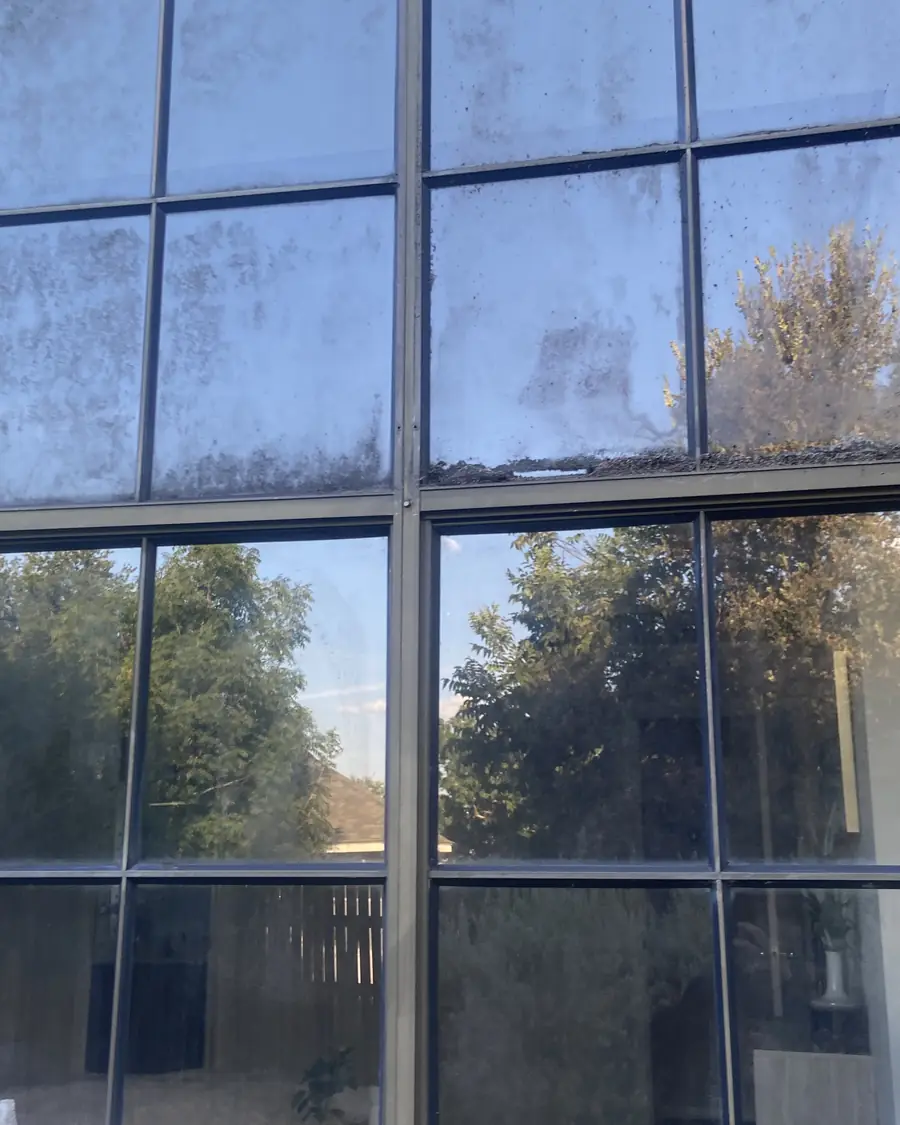
What was behind the screens was the second surprise. A solar screen sits a short distance off the glass and stops rain from ever rinsing it. Dust, pollen and silt blow in through the mesh and stay there. Moisture gets in and is slow to leave. Given a few years, that gap grows its own ecosystem. On this house the screens came off to reveal mold, mildew, lime scale and rust, with years of silt packed along the bottom of the frames.
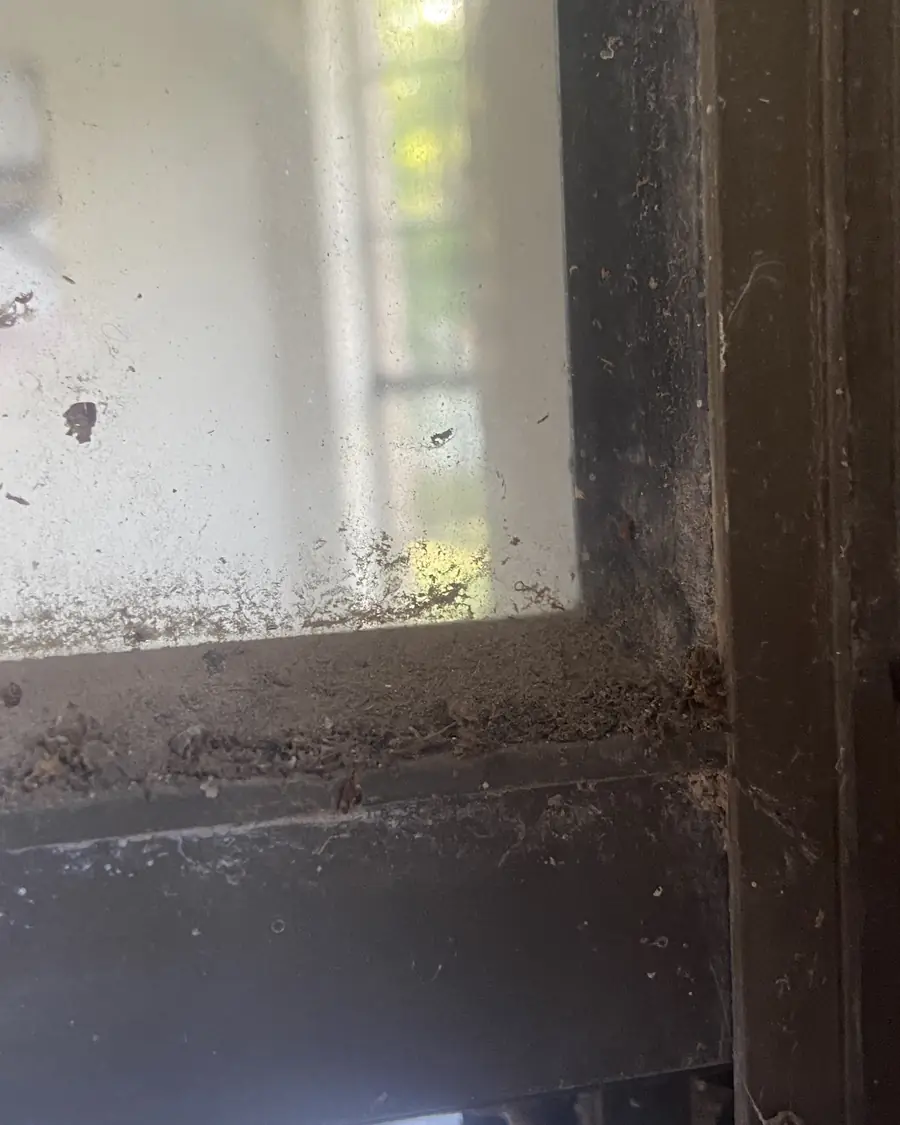
So the job became: take down every screen, break down the growth and the silt, clean out the frames so the dirt does not wash straight back onto the glass, and then clean 407 panes by hand from a ladder. That is three to four times the hours of an ordinary 20 window house, and the price followed the hours. It came to about $800, against the $189 that “20 windows” suggested.
Nothing in that figure was padding. It is the same rate applied to roughly four times the work, and it is why a house like this is always quoted after someone has seen it, not before.
A word on solar screens
Solar screens do a real job, cutting heat through west and south facing glass in a Texas summer. The cost is what builds up behind them. If you have them and want to keep them, have them taken down whenever the windows are cleaned, so the glass underneath gets cleaned and not just the mesh. Left in place for years, they turn a routine clean into a restoration, and restoration is priced as restoration. Mason’s own advice after this house was simpler: this is why he would not put them up in the first place.
What changes a commercial quote
Commercial pricing works differently to residential, and the differences are worth understanding before comparing bids. Our commercial window cleaning quotes move on five things.
- Frequency. For a commercial property the schedule is the service. A storefront cleaned monthly never accumulates the buildup that makes a clean slow, so each visit is quicker and the per visit price is lower than a one off.
- Trading hours. A supermarket that trades from six in the morning until eleven at night has to be cleaned between four and six. A restaurant gets done before Monday service. Working around a business rather than through it is part of what a commercial contract buys.
- Height and access. Water fed poles reach up to around sixty feet from the ground, which covers five to six stories. That matters to a quote because the alternative is a boom lift, a road closure permit or a rope crew, and any one of those costs more than the cleaning does.
- Site constraints. Sterilised drop cloths over open produce, zero VOC products near an HVAC intake at a medical site, permits for work over a public sidewalk. These are not upsells, they are the conditions of being allowed to work there at all.
- Glass condition on day one. Frontages near irrigation often arrive with years of mineral bonded to the lower panes. That is a one time restoration, quoted separately, after which the maintenance visits are straightforward.
Why a schedule costs less than a series of one offs
The single cheapest way to buy window cleaning is on a regular cycle, and the reason is not a loyalty discount. It is that maintained glass takes less time to clean.
Glass left for a year needs the buildup broken down before it can be cleaned at all. Glass done last month needs a rinse and a detail. Same building, same panes, very different amounts of labour. On a commercial site the difference is large enough that a monthly schedule often costs less across a year than two annual deep cleans.
The flip side of that is worth saying too. Some properties genuinely do not need monthly attention, and a low traffic office block is one of them. If you ask for a frequency that is more than the building needs, we will tell you. Selling a schedule that visibly does nothing is how you lose the account in month four.
What a very cheap quote usually means
Cheap quotes are not automatically bad, but they are usually cheap for a reason, and the reason is normally one of these four. Rather than guessing, ask.
- Ask what they rinse with. If the final rinse is tap water, the spots come back with the first dry day, and in this region that is quick.
- Ask how they reach the high glass. A ladder against a gutter is faster and cheaper than a pole. It is also how gutters get bent and how people get hurt on your property.
- Ask whether they carry commercial insurance and ask to see the certificate. Plenty of residential cleaners are covered for houses and not for commercial premises.
- Ask whether hard water restoration is included or extra. If nobody has mentioned it and your lower panes are cloudy, it is extra, and you will find out on the day.
A company that answers those four clearly is worth more than a company that is twenty dollars cheaper.
Common questions about pricing
Do you charge by the window or by the job?
By the job. Window count is where a quote starts, but frame material, glass condition and access change the time required far more than the number of panes does, so a per window rate would be wrong on most properties.
Is a commercial contract cheaper per visit than a one off clean?
Yes, and the reason is that maintained glass is faster to clean. A storefront on a monthly cycle never builds up the deposit that makes a first clean slow, so each visit takes less time and costs less than an equivalent one off.
Why is pure water window cleaning more expensive than a bucket and squeegee?
Because producing water with the minerals stripped out requires a purification system costing between three and five thousand dollars, plus resin that has to be replaced, and Central Texas water is hard enough that the resin exhausts quickly. That cost is real and it is the reason the finish lasts rather than spotting on the first dry day.
Do you quote over the phone or do you need to see the property?
Straightforward residential jobs can be quoted over the phone or by text with a few photos. Commercial sites, anything above two stories, and any property with visible hard water damage need to be seen, because those are the jobs where a phone estimate is most likely to be wrong.
The short version
A window cleaning price in Austin is mostly the cost of purified water, the cost of the equipment that produces it, and the amount of time the glass actually needs. Hard Central Texas water makes the first two more expensive here than almost anywhere else in the country, and the condition of your glass decides the third. Anyone who gives you a number without knowing the property is guessing, and anyone who cannot explain the number is hoping you will not ask.